"The Crucifixion of Jesus"
And the Via Dolorosa Pilgrimage
John 19:17-27 - Bible Study
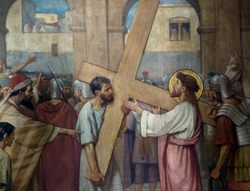
The Via Dolorosa, Latin for "Way of Grief," is the route where Jesus carried His cross, from the House of Pilate to the Crucifixion at Golgotha, the "Place of a Skull."
The Via Dolorosa pilgrimage has been followed since early Christianity, beginning soon after Constantine legalized Christianity in the third century.
Many Christians have taken the walk along the "Via Dolorosa."
The Crucifixion of Jesus
John 19:17-27
Verse 17: "and he went out, bearing his own cross, to the place called The Place of a Skull, which in Aramaic is called Golgotha.
Over the centuries the path has changed several times. Today, the main route of the Via Dolorosa has 14 stations along the way.
Although the route has changed, for most pilgrims, the exact location of each landmark along the Via Dolorosa is of little importance. The pilgrimage has profound meaning due to its proximity to the original events, and the reflection upon them along the way to the crucifixion.
It was not enough to kill the person; humiliation was also a part of the punishment. The victim was usually naked for both the procession and the execution.
The "Place of the Skull," or "Golgotha" was located outside the city
wall, perhaps one thousand feet from Herod's palace. It was customary
for the Romans and the Jews to carry out the crucifixion outside the
towns. The Romans liked the hill because its visibility could be used
as an example to the people
Verse 18: "There they crucified him, and with him two others, one on either side, and Jesus between them."
Several stakes, about ten feet high, stood permanently in Golgotha, ready to be reused whenever a crucifixion occurred.
On the top of the stake, or
slightly below the top, was a groove into which the horizontal beam of
the cross would be inserted after the prisoner had been fastened to it
with ropes or nails. This is where Jesus was crucified. ("IVP Bible Background Commentary")
Verses 19-20: "Pilate also wrote an inscription and put it on the cross. It read, "Jesus of Nazareth, the King of the Jews. "Many of the Jews read this inscription, for the place where Jesus was crucified was near the city, and it was written in Aramaic, in Latin, and in Greek."
It was not unusual for the condemned man to be forced to
carry a title, stating the reason for his crucifixion. The title above
Jesus' cross - written in the three most commonly spoke languages of that
area, read, "JESUS of NAZARETH, THE KING OF THE JEWS."
That was the
title Pilate insisted upon; however, Jesus' claim to be "King of the Jews" was not a capital crime, so the
official charge was, "High Treason against the Emperor."
Verses 21-22: "So the chief priests of the Jews said to Pilate, "Do not write, 'The King of the Jews,' but rather, 'This man said, I am King of the Jews.'" 22Pilate answered, "What I have written I have written."
Pilate no longer had to be concerned with mob
unrest, or of a complaint to the emperor 'Tiberius,' by the Jews,
concerning Jesus.
He did not like the Jewish leaders, and perhaps, none of the Jews. The Jews had blackmailed him into doing their dirty work in crucifying Jesus with no legal reason and caused Pilate to retaliate.
In an act of revenge, Pilate had the title, "King of the Jews" placed on Jesus' cross. He later had a coin minted with the image of one of the most hated Roman leaders, "Tiberius," bearing the augur's wand, a pagan symbol that was despised by the Jews.
There was a city on the western shores of the "Sea of Galilee" named Tiberias after the leader, "Tiberius." It was a large, wicked, Greek oriented City, in which most Jews would not enter.
Verses 23-24: "When the soldiers had crucified Jesus, they took his garments and divided them into four parts, one part for each soldier; also his tunic. But the tunic was seamless, woven in one piece from top to bottom, 24so they said to one another, "Let us not tear it, but cast lots for it to see whose it shall be." This was to fulfill the
Roman law granted the soldiers the right to the clothes the condemned man was wearing.
A military unit was eight soldiers, who would share living quarters, (tent). A 'half unit' would be four soldiers, the usual number assigned to crucifixions, and the reason for the clothes being divided into four parts.
"They divided my garments among them and for my clothing they cast lots." So, the soldiers did these things," (Psalm 22:18), fulfilling the prophecy of Psalm 22:18.
Verse 25: "but standing by the cross of Jesus were his mother and his mother’s sister, Mary the wife of Clopas, and Mary Magdalene."
By His cross was His mother, an unnamed aunt, (His mother's sister), Mary the wife of
Clopas, (believed to be a brother to Joseph), and Mary Magdalene, who became a loyal Follower of
Jesus after He had cast many demons from her.
Verses 26-27: "When Jesus saw his mother and the disciple whom he loved standing nearby, he said to his mother, "Woman, behold, your son!" 27Then he said to the disciple, "Behold, your mother!" And from that hour the disciple took her to his own home."
The 'disciple whom he loved was clearly, "John," the author of this
Gospel. John never refers to himself directly, only in the third
person.
Jesus, being the oldest, would have had the responsibility of
caring for his mother, then later, his younger brothers.
Jesus' statement in front of the witnesses was binding and placed His
mother under His disciple's provision and care.
For a
disciple to be asked to care for his teacher's family was a great
honor. Mary was possibly in her mid to late forties, a widow, living in a society where women earned very little
money.
This concludes our study of, "The Crucifixion of Jesus,"
Our Next Study Is:
The Death of Jesus on the Cross.
Gospel of John Bible Study, Main Page
"Lets Teach Our Children to Love"
Why is it so difficult for our educators and society, in general, to understand that love and respect for one another taught from a young age can solve much of the world's hostility and social problems!
"Train up a child in the way he should go, And when he is old he will not depart from it" (Prov 22:6).
Love is the answer!
Loyalty and Faithfulness
True loyalty springs from the heart and is wrapped in love. It is often in our most private moments that true loyalty, or the lack of it, is made known.
Reaching the World
With the Message
Of Jesus

Recent Articles


-
Commandments of Jesus
Apr 24, 24 11:11 AM
Our God is the God of Grace - and expectations. Jesus said, "If ye love me, keep my commandments" (Jn 14:15). These are the Commandments of Jesus. -
Prayer Requests
Apr 24, 24 11:05 AM
God answers prayer. Submit your prayer requests and have other Spirit Filled Christians pray for you -
Powerful Christian Testimonies - Submit Your Testimony
Apr 23, 24 12:52 PM
Powerful Christian Testimonies tell how God interacts, empowers, encourages, and works miracles on behalf of His people. -
Daniel Cahill
Apr 22, 24 12:28 PM
 Daniel Cahill is a devoted Christian who shares his Christian insight and love with those who live on the streets of New York City, Miami, and the world.
 -
Dreams From Heaven Supernatural and Glorious
Apr 22, 24 12:20 PM
 Large collection of mysterious, fascinating Christian visions and dreams. Please Submit your dream.



Samuel L Mills
PO Box 4456
Maryville, TN 37802