"The Betrayal and
Arrest of Jesus"
John 18:1-14 - Bible Study
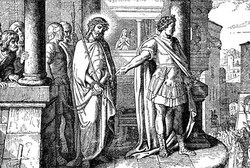
The Betrayal and Arrest of Jesus seem to have occurred immediately following, "The Great Intercessory Prayer of Jesus."
Jesus was not so much the victim, as the orchestrator of events. He was in complete power at His trial, sentence, and crucifixion. Nothing happened to Him outside of His control; He could have stopped the process at any moment.
The Betrayal and Arrest of Jesus
John 18:1-14
Verse 1: "When Jesus had spoken these words, he went out with his disciples across the Kidron Valley, where there was a garden, which he and his disciples entered."
The Kidron Valley is a dry waterbed with water only during the rainy season, so crossing it in April would not have involved getting wet. The site is still identifiable.
The garden is the "Garden of Gethsemane." It is located somewhere on the lower slopes of the Mount of Olives and is very likely where the arrest of Jesus took place.
Verse 2: "Now Judas, who betrayed him, also knew the place, for Jesus often met there with his disciples.
Judas, "Knew the place," means that he was very familiar with the Mount of Olives and knew this was where they would find Him.
Verse 3: So Judas, having procured a band of soldiers and some officers from the chief priests and the Pharisees, went there with lanterns, and torches and weapons."
To Procure means to - “to obtain something, especially by effort.” Not only did Judas betray Jesus, but also assembled the soldiers and officers who went with him.
The officers of the Chief Priest and Pharisees arresting Jesus were most likely temple guards who had authority under the Jewish leaders to make arrests.
The Roman soldiers did not arrest Jesus; they merely accompanied the temple guard for added security.
An indication of how poorly He was understood by the authorities, is that they brought torches and lanterns in their search for the Light of the World.
Verse 4-5: "Then Jesus, knowing all that would happen to him, came forward and said to them, "Whom do you seek?" They answered him, "Jesus of Nazareth." Jesus said to them, "I am he." Judas, who betrayed him, was standing with them."
John only tells us that Judas was standing with them. He does not mention Judas' kiss, which would have taken place just before or after Jesus' question. (IVP New Testament Commentary)
Jesus fully realized all that would happen to Him, yet, stepped forward, and asked who they were looking for. When they said, "Jesus of Nazareth," He responded with, "I Am He."
Verse 6: "When Jesus said to them, "I am he," they drew back and fell to the ground."
Although it may seem that Jesus is just acknowledging that He is Jesus from Nazareth, this Scripture another one of the great "I AM" statements that Jesus used to identify His Deity, as "God the Son."
This would explain why His Words had such an impact on the troops. The mighty Roman Soldiers and the highly trained temple guards fell to the ground from the power unleashed by His Words. We are not told that Judas was among those who fell.
Verse 7-8: "So he asked them again, "Whom do you seek?" And they said, "Jesus of Nazareth." Jesus answered, "I told you that I am he. So, if you seek me, let these men go."
Even at this point, Jesus is protecting His own, giving Himself up on their behalf.
Verse 9: "This was to fulfill the word that he had spoken: "Of those whom you gave me I have lost not one."
At least twice, Jesus has made the statement that none of those the Father had given Him were lost, except for Judas Iscariot.
Verse 10: "Then Simon Peter, having a sword, drew it and struck the high priest’s servant and cut off his right ear. (The servant’s name was Malchus.) So Jesus said to Peter, "Put your sword into its sheath; shall I not drink the cup that the Father has given me?"
Here, in John's eyewitness account of the arrest of Jesus, Peter impulsively cuts off the ear of the high priest's servant.
This servant was an influential person with much authority. We also see the love, mercy, and healing power of Jesus.
Jesus was in complete control, and did not allow anything to interfere with, "the cup of suffering" He was about to endure. He was determined to carry out the mission assigned to Him by the Father.
Verse 12: "So the band of soldiers and their captain and the officers of the Jews arrested Jesus and bound him."
The Greek translation of the word, "Captain" literally means, "One in charge of a thousand men."
So, they arrested Jesus, bound him as a common criminal, and took him to Annas for Questioning.
Although Jesus was in complete control, He allowed Himself to be bound and led as a sheep to the slaughter.
Prophecy: "He was oppressed, and he was afflicted, yet he opened not his mouth; like a lamb that is led to the slaughter, and like a sheep that before its shearers is silent, so he opened not his mouth," (Isaiah 53:7).
Jesus Questioned by Annas
Verse 13-14: "First they led him to Annas, for he was the father-in-law of Caiaphas, who was high priest that year.
The office of "High Priesthood" was the most powerful office in Jewish Palestine, and Caiaphas was the high priest.
Annas, was his father in law, and had been the previous high priest, but had been removed by the Roman government.
Nevertheless, they took Jesus to Annas first. Most believe this was because he was thought to have more power and influence than Caiaphas.
According to Jewish Law, no single individual could act as judge in a capital case, but this would not stop Annas from privately interrogating Jesus.
Verse 14: "It was Caiaphas who had advised the Jews that it would be expedient that one man should die for the people."
In John 11:50 Caiaphas had said: "Nor do you understand that it is better for you that one man should die for the people, not that the whole nation should perish,"
This concludes our study of, the Betrayal and Arrest of Jesus.
Our Next Study is:
The Gospel of John Bible Study Main Page
"Lets Teach Our Children to Love"
Why is it so difficult for our educators and society, in general, to understand that love and respect for one another taught from a young age can solve much of the world's hostility and social problems!
"Train up a child in the way he should go, And when he is old he will not depart from it" (Prov 22:6).
Love is the answer!
Loyalty and Faithfulness
True loyalty springs from the heart and is wrapped in love. It is often in our most private moments that true loyalty, or the lack of it, is made known.
Reaching the World
With the Message
Of Jesus

Recent Articles


-
Prayer Requests
Apr 25, 24 09:30 PM
God answers prayer. Submit your prayer requests and have other Spirit Filled Christians pray for you -
Dreams From Heaven Supernatural and Glorious
Apr 25, 24 12:22 PM
 Large collection of mysterious, fascinating Christian visions and dreams. Please Submit your dream.
 -
Commandments of Jesus
Apr 24, 24 11:11 AM
Our God is the God of Grace - and expectations. Jesus said, "If ye love me, keep my commandments" (Jn 14:15). These are the Commandments of Jesus. -
Powerful Christian Testimonies - Submit Your Testimony
Apr 23, 24 12:52 PM
Powerful Christian Testimonies tell how God interacts, empowers, encourages, and works miracles on behalf of His people. -
Daniel Cahill
Apr 22, 24 12:28 PM
 Daniel Cahill is a devoted Christian who shares his Christian insight and love with those who live on the streets of New York City, Miami, and the world.



Samuel L Mills
PO Box 4456
Maryville, TN 37802